How Public Meetings Work Without a Formal Agenda
Learn how public meetings can proceed without a formal agenda, using clear topic lists, shared ground rules, and written follow-up to keep decisions visible.
At a neighborhood meeting, the chair may read a resident’s question aloud, then ask who wants to speak before moving to the next concern. That is a meeting without a formal agenda, but not without a process. Public meetings without agendas still need a way to identify business, invite participation, and keep track of what remains unresolved.
What replaces a formal agenda?
There is no single substitute. A group might use a chair’s spoken sequence, a clerk’s list of requests, a posted notice, or a shared document. These methods can help people follow the discussion, but they are not interchangeable: a spoken list is easy to change, while a written list gives participants something they can revisit.
It is better to describe these as possible meeting practices than as a universal historical pattern. Without a specified place and period, broad claims about how public meetings used to run would overstate what we know. The practical point is narrower: a group can conduct business without a document called an agenda, provided participants understand how topics will be raised and tracked.
How can a chair keep discussion legible?
The chair can name the current subject, explain who has the floor, and state when the group is moving on. A clerk or note-taker can record each topic and its status. These simple cues help residents distinguish between a matter being discussed and one being decided.
A public meeting also needs to account for people who arrive late or cannot follow every exchange. A visible list on a whiteboard or a printed sheet can show what is pending. If the group changes the order, the chair can say so aloud and the clerk can note the change.
What should a group check before proceeding?
- Topic clarity: Check whether each item says what the group will discuss; if residents could mistake its meaning, rewrite it in plain language, or ask the person raising it to clarify.
- Decision status: Check whether the group expects to decide, discuss, or refer the matter; if the next action is known, state it, or leave the outcome open and record that no decision is planned yet.
- Speaking order: Check whether participants know how to request the floor; if the method is unclear, announce a simple procedure, or pause until the chair can explain one.
- Visibility: Check whether people in the room can see or hear the current topic; if they cannot, read it aloud or display it where they can follow.
- Unfinished business: Check whether prior open matters have a recorded next action; if they do, carry that action forward, or ask the group to decide who will clarify the missing detail.
- Meeting rules: Check the applicable bylaws, public-notice requirements, and local rules; if they specify an agenda or a particular procedure, follow those requirements, or consult the appropriate clerk or qualified professional when interpretation is needed.
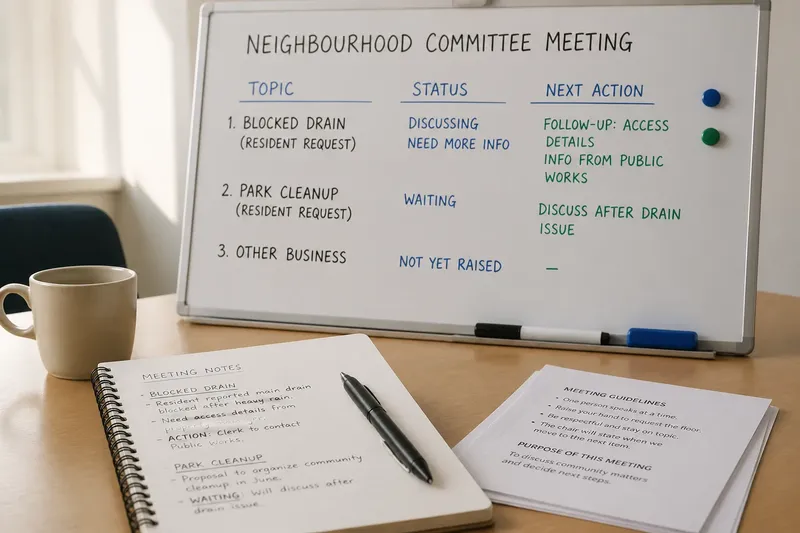
Imagine a fictional neighborhood committee receives two requests: a resident wants to discuss a blocked drain, and another wants to plan a park cleanup. The chair writes both topics on a whiteboard, asks the group to take the drain issue first because residents need to discuss access, and records that the cleanup proposal is still waiting. During discussion, members decide they need more information about the drain; the clerk records that follow-up rather than marking the matter resolved. The resulting sequence is visible, and the next action is clear, even though the committee used no formal agenda document.
What is the tradeoff between spoken and written order?
A spoken sequence is flexible and quick to adjust. That can help a small group respond to a participant or an urgent concern. But people who arrive late may miss the order, and a change can be difficult to reconstruct afterward.
A written list takes more preparation, yet it gives everyone a common reference and helps the clerk record what happened. Neither format settles whether the order is fair. Placing a topic first can give it more time, while moving it later can leave less room for discussion. A chair should explain significant changes so participants can understand the choice.
What questions do people ask about meetings without agendas?
Can a public meeting proceed without a written agenda?
That depends on the rules that govern the particular body. Check its bylaws and applicable public-notice requirements before relying on an informal process; if the rules are unclear, ask the responsible clerk or a qualified professional.
How can residents know what will be discussed?
The group can share a topic list, post a notice, or have the chair read the planned subjects aloud. If the governing rules require a particular form or timing of notice, that requirement takes precedence.
Who keeps track of decisions and unfinished topics?
A clerk or designated note-taker can record the topic, the action taken, and any follow-up. If there is no note-taker, the chair should identify who will make the record before discussion begins.
What should happen when the meeting changes its order?
The chair can announce the change and give a brief reason, while the clerk updates the visible list or meeting notes. If the change affects required notice or procedure, pause and check the applicable rules before proceeding.
What is not worth the effort?
Do not spend meeting time polishing labels that participants cannot understand, or create a separate item for every passing comment. A short, plain-language list and a reliable note of what remains open are more useful than elaborate formatting.
For public meetings without agendas, the most important safeguard is a shared understanding of what is being discussed and what happens next. A visible topic list, clear speaking cues, and a record of unresolved business can make an informal process easier to follow. Before adopting that approach, check the rules for the specific public body; the right process is the one participants can understand and the institution is permitted to use.