What a Public Service Is Designed to Do
Learn to read a public service description by separating its purpose, intended users, and covered tasks, so you can tell what help it actually offers.
You open a city website looking for help with a broken streetlight and land on a page about “neighborhood infrastructure services.” What does that promise: a repair, a way to report the problem, or simply information about who handles it? To read a public service description clearly, separate its purpose, the people it is meant to serve, and the tasks it actually covers.
What does a service description promise?
A service description is a compact account of public work. It may name an outcome, such as keeping sidewalks usable, or an activity, such as inspecting public walkways. Those are related, but they are not the same promise. An outcome describes the condition a service aims to support; an activity describes work the service performs.
That distinction matters because broad purpose language can sound more comprehensive than the service itself. “Support safe travel” might describe an aim shared across several programs. It does not, by itself, say that one office repairs every road hazard or responds to every report.
Look for concrete verbs. “Accepts reports,” “inspects,” “maintains,” “refers,” and “issues permits” point to different kinds of work. A description that says a service “supports” residents may be naming a broad purpose while leaving its actual duties to another section of the page.
Which parts should you compare?
There are three useful ways to read the same description. Each answers a different question, and none should be mistaken for the whole service.
- Purpose-first: Start with the problem the service exists to address. This approach suits someone trying to understand why the service belongs in public administration or how it relates to a larger community need.
- User-first: Start with the people or places named as eligible or intended users. This suits someone deciding whether a service appears relevant to them, their household, or their neighborhood.
- Task-first: Start with the actions the service says it performs. This suits someone who needs to know what to request, report, submit, or expect next.
For practical questions, task-first reading is often the quickest route. But it can miss limits hidden in the user description. User-first reading can clarify who may request help, but may not tell you whether the service handles the issue itself or passes it along. Purpose-first reading gives useful context, yet broad aims are especially easy to overread.
Read all three as separate layers. A service can have a broad public purpose, serve a defined group, and cover only a narrow set of tasks. That is not necessarily a contradiction. It may simply divide responsibilities among services.
Who is meant to use it?
Descriptions may name residents, property owners, tenants, visitors, businesses, or particular neighborhoods. They may also describe the service area, such as city streets rather than privately managed roads. These phrases help define the intended users and the boundary of the work.
Do not assume that a named group is the only group that benefits, or that everyone who benefits can make a request directly. A page about maintaining public parks may benefit nearby residents while assigning requests to park users, authorized organizations, or staff. The wording should tell you what role the public has, not just who gains from the outcome.
Notice whether the page says “for,” “available to,” “serves,” or “managed on behalf of.” Those phrases can signal different relationships. “For residents” may identify the audience; “available to residents” may suggest access; “serves the district” may describe a geographic reach. If the wording is vague, look for eligibility, service-area, or contact details rather than guessing from the title.
What work is actually included?
Task language is where a service description becomes useful for a decision. Separate direct work from supporting work. A direct task changes or handles the issue itself, such as clearing a public drain. Supporting tasks might include receiving a request, inspecting the location, keeping records, or referring the matter to another unit.
Imagine a resident notices a damaged sign at the entrance to a public trail. The service page says it maintains trail facilities, accepts reports from park visitors, and refers signage concerns to a transportation office. The purpose is to keep trails usable; visitors are among the intended users; the covered tasks include reporting and referral, while the repair may sit elsewhere. The resident can use the page to send the report without assuming the same service will make the repair.
Look for boundaries as carefully as for duties. A description may exclude private property, emergencies, specialized equipment, or work handled under a separate program. The point is not to hunt for every possible exception. It is to identify the boundary that affects the action you are considering.
Which details do readers often search for?
Does a service purpose mean it handles every related problem?
No. A purpose describes the public need a service is intended to address, not necessarily every task connected to that need. Check the listed activities and exclusions before deciding where a specific request belongs.
How can I tell whether I am an intended user?
Look for named groups, eligibility language, and the stated service area. If the description names a place or type of user that does not clearly include your situation, use the page’s contact route to ask which service applies.
What does it mean if a service refers requests elsewhere?
It means the service may receive or assess an issue without owning the next action. A referral can still be part of its work, but it is different from carrying out the repair, decision, or assistance directly.
Where should I look if the description is too broad?
Check linked pages for eligibility, service boundaries, tasks, and request channels. If the answer depends on a label, the service provider’s instructions, or local rules, follow those details or ask the responsible office.
How should you choose a reading approach?
Choose according to the question you need answered. If you are trying to understand why a program exists, begin with its purpose. If you need to know whether it applies to your situation, begin with its intended users and service area. If you need to act, begin with its tasks and request process.
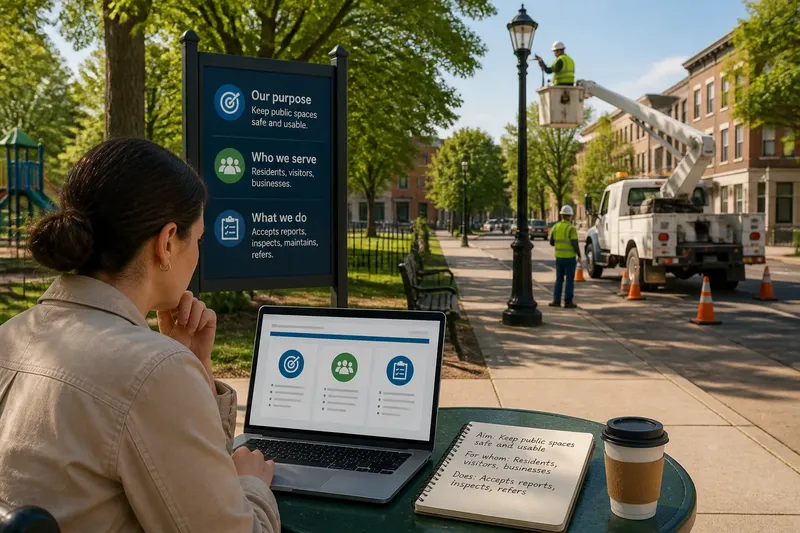
Then make a quick three-part note: “aim,” “for whom,” and “does.” A short phrase under each can expose gaps without turning a web page into a research project. For example, “aim: keep public paths usable; for whom: park visitors; does: inspect and report damage” is more informative than a service title alone.
What is not worth the effort? Trying to infer every responsibility from an office name, a slogan, or one broad sentence. Names are often designed to cover a portfolio, not to explain the limits of a particular service. Follow the verbs and boundaries instead.
When you read a public service description this way, its purpose stops standing in for its full scope. You can see who it is meant to serve, what work it covers, and where a request may need to go next. That small distinction makes the next call, form, or search more focused.