Reading a Policy Proposal Without Getting Lost in the Labels
Reading a policy proposal is easier when you separate its aim, proposed action, affected groups, and open questions before weighing the labels.
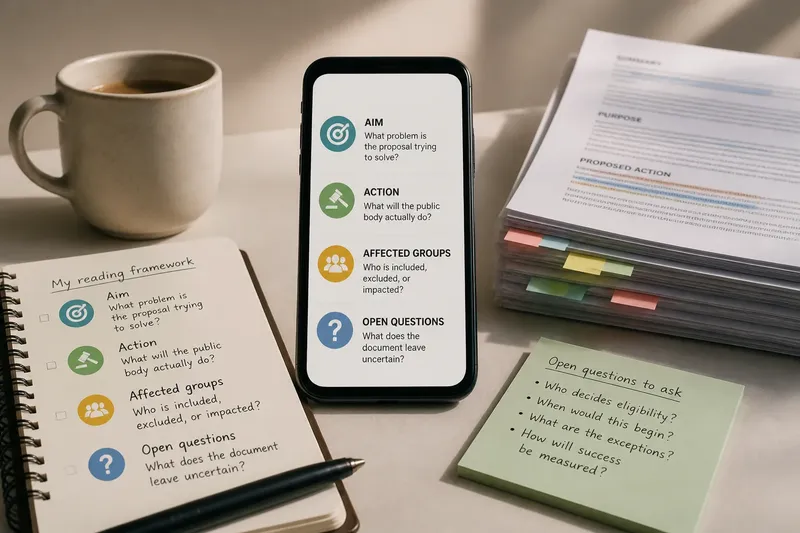
You open a city policy proposal on your phone while waiting for the bus. The title says “Neighborhood Access Initiative,” the first page praises “equity and modernization,” and the actual change is buried several pages down. Reading a policy proposal gets easier when you set the labels aside long enough to identify its aim, action, affected groups, and unanswered questions.
This is not a test of whether you know government jargon. It is a way to tell what the document says the public body intends to do, who may notice the change, and what the proposal leaves unclear. The right reading approach depends on why you opened the document. Start with your situation, then use the same four-part method to check the substance.
What are you trying to decide?
If you need to know the basic change before a meeting or conversation, read for the proposed action first. Search for verbs such as “require,” “replace,” “authorize,” “limit,” or “fund.” They often reveal more than a polished title or a paragraph about broad goals. Write the action in one plain sentence, without the program’s branded name.
If the proposal affects your work, household, neighborhood, or organization, begin with the affected groups. Look for eligibility rules, locations, deadlines, exceptions, and who must apply or comply. A policy can sound broad while applying only to a particular service, property type, or set of residents.
If you are preparing to comment, focus on unanswered questions. Note what the document does not specify, such as who decides eligibility, how exceptions work, or when a change would begin. A focused question can clarify the proposal more usefully than a general reaction to its wording.
If you are comparing competing proposals, use the same four headings for each: aim, action, affected groups, and open questions. This keeps differences visible even when the documents use different slogans. Do not compare a stated goal in one proposal with an operational detail in another; compare like with like.
How do you find the stated aim?
Search for the problem the proposal says it is addressing. The aim may appear in an opening summary, a “purpose” section, a staff explanation, or a recital that describes current conditions. Record the problem as the document presents it, not as you assume it to be.
Then separate the problem statement from the promised result. “Reduce missed appointments” describes a desired outcome; “send text reminders” describes an action. The distinction matters because a document can state a worthy aim without explaining how its proposed action is expected to contribute to it.
Watch for value words such as “fair,” “efficient,” “safe,” and “accessible.” They may explain the proposal’s rationale, but they do not by themselves tell you what will change or how the public body will judge success. Treat them as clues about the stated aim, not as evidence that the action is fully specified.
Which action does the document actually propose?
Find the operative language: the part that creates a rule, changes a process, assigns responsibility, or authorizes spending. In a draft ordinance, this may be in the proposed text rather than the cover memo. In a service plan, it may appear under “implementation” or “recommended action.” If the summary and the operative section seem different, make a note of both rather than silently choosing the clearer version.
Rewrite the action as a sentence with an actor and a verb: “The department will…” or “Applicants must….” If you cannot complete that sentence from the document, the proposal may not say who is expected to act. That is a meaningful gap, not a reading failure.
Next, distinguish a binding requirement from an intention. “Must submit” reads differently from “may consider,” “plans to,” or “encourages.” The exact force of a term can depend on the document type and local rules, so consult the issuing office or a qualified professional when a legal obligation matters. For ordinary reading, mark the wording as firm, discretionary, or aspirational rather than treating those forms as interchangeable.
Imagine a hypothetical proposal whose title promises “Faster Permit Review.” Its summary says the city wants shorter waits, while the operative section says applicants must use a new online form and staff may request additional documents. A plain-language restatement would be: “Applicants must use the new form, and staff can ask for more material.” The stated aim is faster review; the described action is a changed application process. The text alone may not explain whether that process will shorten waits.
Who could be affected, including indirectly?
Look beyond the group named in the title. Check who must take an action, who can qualify for a benefit, who is excluded, and who administers the change. A proposal about permits might directly affect applicants while also changing work for neighborhood groups, contractors, or staff who answer questions.
Scan for definitions and boundaries. Terms such as “resident,” “small business,” “low-income household,” or “priority area” can have narrower meanings inside a policy than they do in everyday speech. Note any stated geography, eligibility condition, exemption, or appeal route. If the document gives none, record that absence rather than guessing who qualifies.
Consider access in practical terms. Does the proposal assume access to a smartphone, a particular language, an appointment during business hours, or a document that some people may not have? Those questions do not prove the policy will exclude anyone, but they can identify what the document has not addressed. Keep the question tied to the text: “Does the proposal offer another way to apply?” is more precise than “Is this fair?”
What questions does the proposal leave open?
Separate missing details into useful categories. This makes it easier to ask a clear question and harder to mistake a vague concern for a settled fact.
- Responsibility: Which office or role carries out the action, and who handles a problem?
- Eligibility: What terms or documents determine who is included?
- Timing: When would the change begin, and what happens to requests already in progress?
- Exceptions: Can someone request an alternative, and who decides?
- Review: How can a person ask for a correction or challenge a decision?
- Evaluation: What observable sign would tell the public body whether the stated aim is being met?
Not every proposal must answer every question in one document. The useful point is to distinguish a detail addressed elsewhere from one that has not been answered at all. If the proposal names a related rule, form, or implementation plan, note its title and check whether it resolves your question. If it does not, keep the question open.
What is not worth the effort? Trying to decode every slogan, acronym, or adjective before you know what action is proposed. Look up a term if it changes who must do what; otherwise, park it and keep reading. A glossary can clarify vocabulary, but it cannot fill a missing policy detail.
Which reading questions should you ask?
Where is the real policy change?
Look for the section that uses operative verbs or amends an existing rule, not just the introductory summary. Compare that passage with the summary if their wording appears to promise different things.
How can I tell a goal from a requirement?
A goal describes an intended condition, while a requirement tells someone what they must or may do. Identify the actor and verb; if either is absent, the document may not specify an enforceable action.
What if the proposal uses an unclear label?
Check whether the document defines the term and whether the definition affects eligibility, duties, or exceptions. If it remains unclear, ask the issuing office what the label means in this proposal rather than relying on its everyday meaning.
What should I do with questions the document does not answer?
Write each one as a direct question and connect it to a passage or missing detail. Send it to the listed contact or raise it in the relevant public process, while keeping your own notes clear about what the text states and what you are asking.
How can you turn your notes into a clear response?
Use a short four-line note: “The proposal aims to…,” “It would…,” “It affects…,” and “It does not yet explain….” Keep each line grounded in the document. This format works for a personal decision, a conversation with a neighbor, or a comment to a public office because it separates interpretation from questions.
Say you are reading a hypothetical library proposal that aims to make room scheduling easier. The document would require groups to reserve rooms through an online portal, but says nothing about people who cannot use that portal. Your note can state the aim and action plainly, identify groups that may need another option, and ask whether an in-person or phone route will remain available. That is more useful than arguing over whether “modernization” is a good label.
When you search for “reading a policy proposal,” look for the same four anchors each time: the stated aim, the concrete action, the affected groups, and the open questions. Labels can frame a decision, but they do not substitute for its terms. The most useful final note is often the one that says exactly what the document tells you—and names the one point you still need answered.